Newton integrates the hyperbola by using the ‘extraction of roots’ method – basically guessing and checking for increasingly higher order terms of a tentative polynomial expansion. He then integrates the resulting infinite algebraic expression term by term.
Note that he does not use the binomial theorem here, although it would have made his life easier.
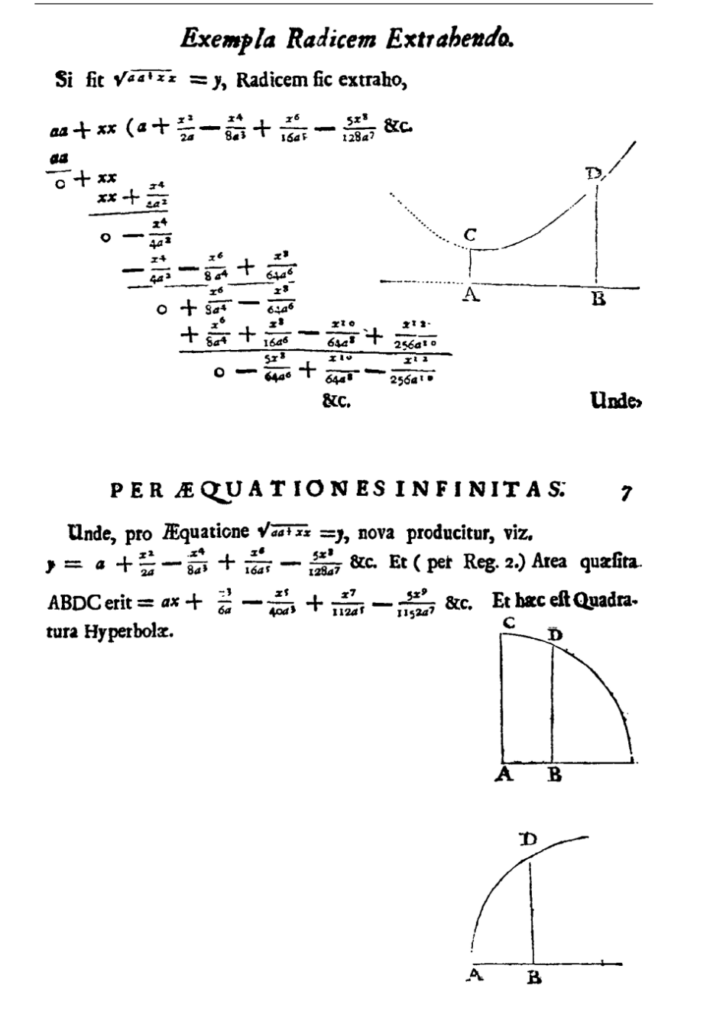
Translation (from Stedall Ch8, Power Series):
Note that the translation is accurate but the formatting is a bit different from newton’s writing.
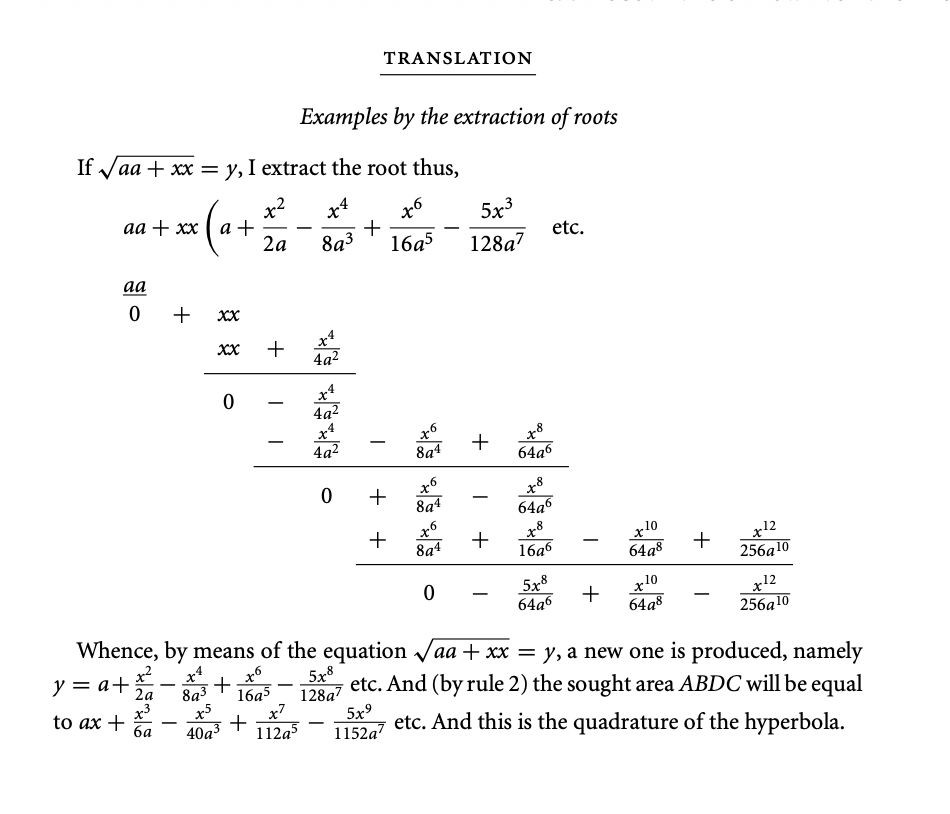
The first thing to understand is that the left bracket has nothing to do with bracketing. Instead it is supposed to separate the square of the answer from our answer.
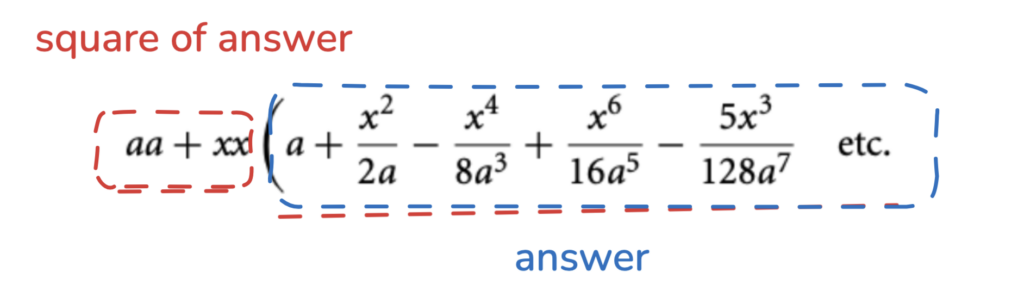
We start with ‘guessing’ the answer a. This is the first term on the right of the open bracket ( above:
Now we note that:
Which corresponds to the following:
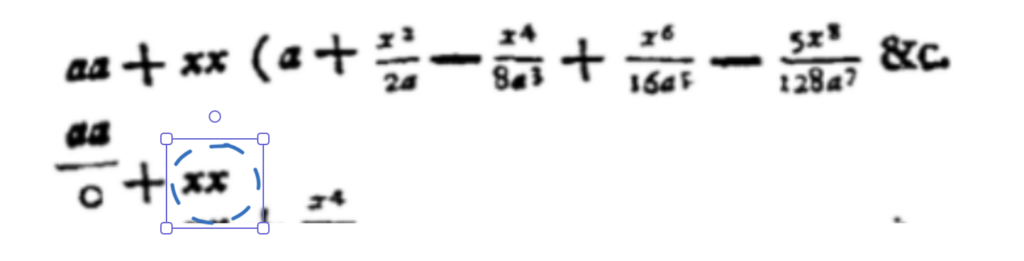
The line
should be taken to mean “this is the remainder when we take our preliminary guess for the square root away from our target square aa+xx.
Clearly, a is not the best estimate for the square root of a squared plus x squared, but it’s a start. It seems that x is assumed to be small, so it is also the best 0th order approximation we have. In order to do better, we propose the following estimate:
This corresponds to the first two terms of the right hand side of the equation:
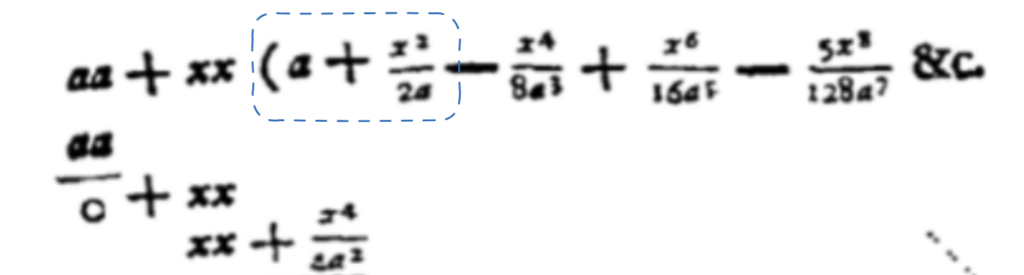
The utility of the second term become clear when we square the 2-term expression and find that the cross terms combine to give:
This is what is happening here:
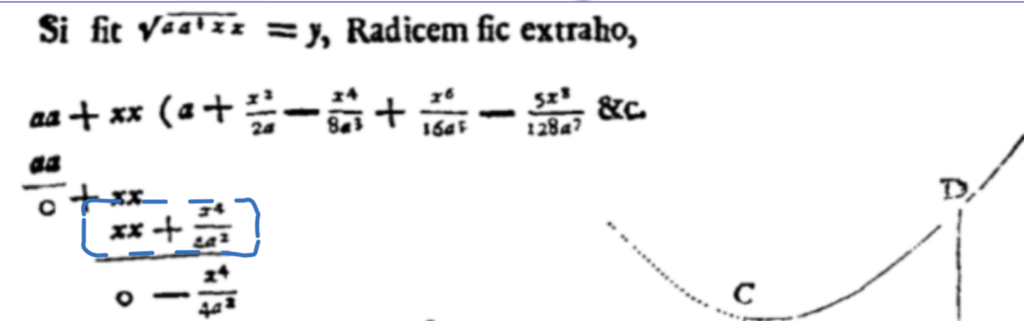
The line:
Is simply the result of squaring the two-term preliminary result for the square root of $a^2 + x^2$ (The $a^2$ term is not omitted because it will always disappear when taking the difference with aa+xx. These ‘missing terms’ can be brought down, but they would have to be brought down for each iteration of the ‘squaring and differencing procedure’, see below:
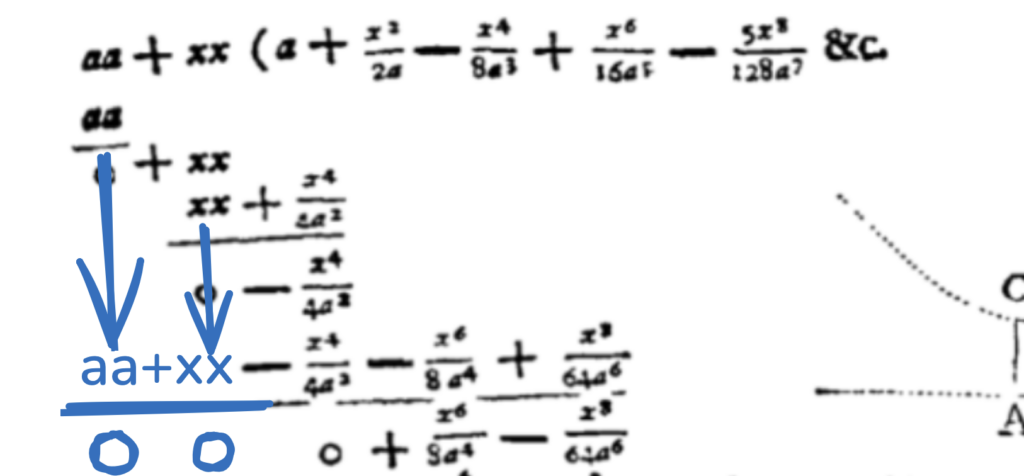
So each step involves squaring the preliminary answer and taking that squared away from $a^2+x^2$. We now have a two term expansion for $\sqrt{a^2+b^2} = a+x^2/2a$ but it is not enough. The $x^4/8a^3$ term makes sense because we want something to cancel the $x^4/4a^2$, and we know that when expanding we will get two lots of $x^4/8a^2$. The only new cross term is $x^2/2a \times x^4/8a^3$, which occurs twice – and $x^8/64a^6$ results from the square of the term we just introduced. All the other cross terms cancel or produce useful stuff like $x^2$. So we have just found that
Where the $-x^4/4a^2$ terms have cancelled.
This explains the lines circled below:
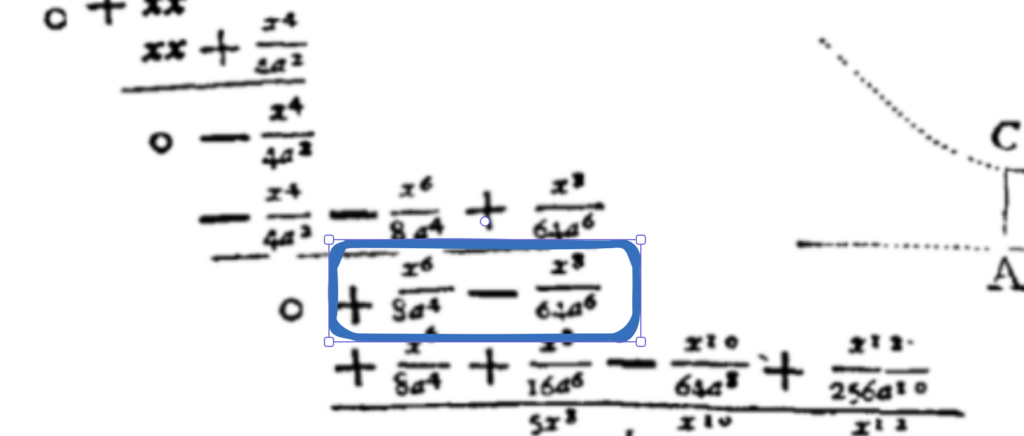
Next we want to eliminate the two higher order terms $x^6/8a^4$ and $-x^8/64a^6$. The $x^6$ term must be $x^6/16a^5$ because this term will again feature twice in the cross-multiplication. It is not so clear to me where the $5x^8/128a^7$ term comes from.
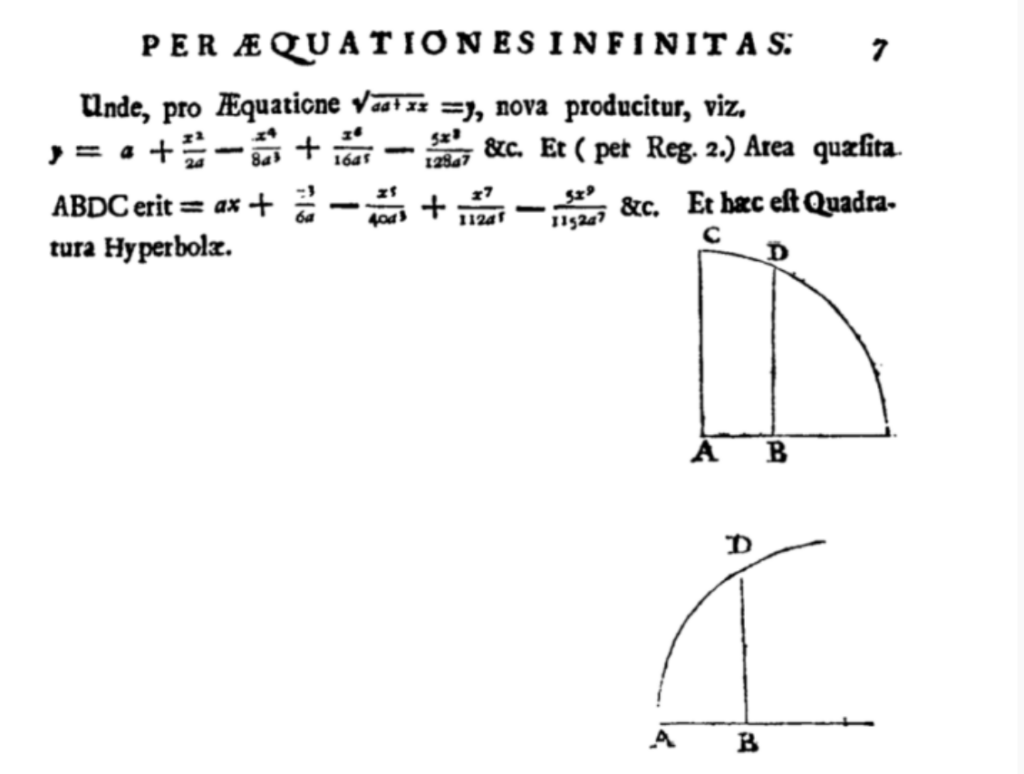
At the end of the exercise we have found a polynomial expansion of the curve, which we can then integrate (find the Quadrature):
Leave a Reply